Being close to many wonders is a real fortune! Our structure is not only close to some of the most famous cities in Italy, such as Venice and Verona. The Hotel Antica Corte Marchesini, in fact, also offers the opportunity to visit lesser-known destinations.
Today we will guide you through the minor itineraries of our area. Discover what beautiful places to explore during your stay at our hotel!
Church of Santa Giustina and Idrovora di Lova, symbol of the reclamation of the Venetian territory
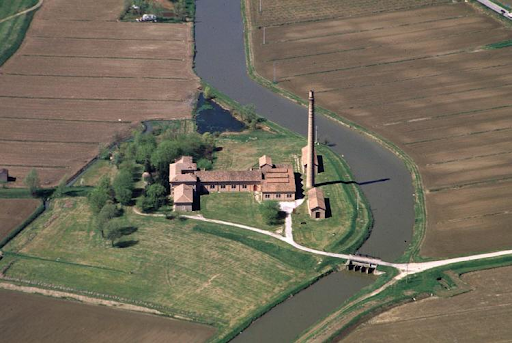
Just 7 minutes drive from Corte Marchesini is Lova, a fraction of our lush Campagna Lupia. Those who visit always plan a stop at the hydrovorous plant of the town. It is an important artifact of industrial archaeology dating back to the years 1890/1892. With its over 100 years of history, it has a flow rate of about 12,000 liters per second.
Due to the historical value of the plant, the old diesel engine and one of the steam engines have been retained. In addition, on the occasion of Expo 2015, together with the waterways and other excellences of the area, the water hole was one of the stages of the tourist route designed by the Union of Municipalities cities of the Riviera del Brenta.
During your excursion to Lova, we suggest you also visit its Church. We tell you a curious anecdote. It seems that, since 1025 and throughout the Middle Ages, the names of Lova and Lupa continuously alternate in the notarial acts of the time. Lova faced floods and passages of armies that flooded and destroyed the church. So, in 1489, it was established as a substitute for that of Campagna, which assumed the attribute of Lupia.
When you arrive in the Church you will see paintings ranging from the sixteenth to the eighteenth century, even if the plaque placed at the entrance confirms that the church dedicated to Santa Giustina dates back to 1236.
The picturesque church of Santa Maria in Lugo
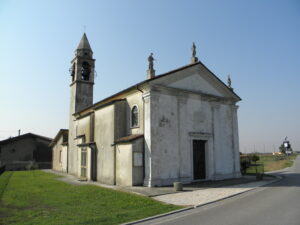
Even closer to our hotel (only 4 minutes by car), is the small Lugo, frequented since the early Iron Age. It seems that its name goes back to “sacred wood” and is linked to the paleoveneto sanctuary located in Lova. What is certain is that in the Middle Ages in Lugo was erected the church of Santa Maria. Built in the first half of the thirteenth century, the area where it stands was initially inhabited. However, following the hydraulic works carried out by the Serenissima Republic to save the lagoon, the area became marshy. In 1700 it was completely restored. This is shown by the inscription on the upper part of the altar.
Its church is one of the most important monuments of the municipality of Campagna Lupia from the historical and religious point of view and includes a chapel and the sacristy.
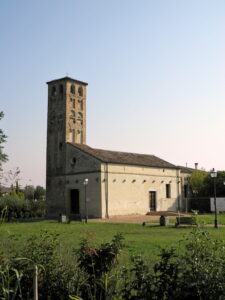
During your visit you will find yourself in the churchyard, made of terracotta as the bell tower, decorated on all the walls. But what amazes you, even before entering, will be the appearance of the church, which is presented with only half a facade. A very original little architectural jewel!
In the years between 1989 and 2012 were found in the area of the ancient Sanctuary of Lova and between 2008 and 2010 in the churchyard of the church of Santa Maria di Lugo important archaeological finds of the Bronze and Iron Age; votive bronzes dating from the second to the third century B.C. depicting male figures, horses and horsemen, gold rings, Romanesque coins, pottery and architectural decorations that adorned the buildings have been found.
These finds will soon be exhibited in display cases in the central hall of the main floor of the Municipality of Campagna Lupia to offer the opportunity for tourists to view them together with temporary exhibitions of paintings and photographs by local artists.
History and finds in Mino Meduaco and the Ethnographic Museum of Lova
Always very close to our location (5 minutes!) is the Mino Meduaco Archaeological Group. This volunteer association has discovered over 200 sites, including pre-Roman, Roman and medieval. We invite you to take part in the archaeological-educational exhibition “Gianna Ravagnan”. You will have the opportunity to see the testimonies of the first forms of manual man. You will see the reconstructions in wood, natural fibers, flint and stone of the most ancient artifacts built by the human being.
In addition to the numerous finds and votive objects, you can get a picture of the reality of the inhabitants of the time. Examples include agricultural activities, clothing and personal effects, such as jewellery and engraved cameos. Religion also has a dedicated space. The funerary sphere is described in detail. In fact, you will discover three-dimensional reconstructions of different types of tombs and possible outfits.
The original name of the museum comes from the Mansio Mino Meduaco in Lova, one of the many rest stations on the Rimini-Altino route. In these areas man found rest and changed animals, especially horses.
You can continue your cultural trip in the direction of MUS.TE.LA, the Museum dedicated to the valleys and lagoon of Venice. The collection, restoration, cataloguing and partial exposition of artefacts and tools related to fishing, film-making, fishing and hunting began in the 1980s.
As the French George Henri Rivière wrote, “The ethnographic museum is a mirror in which a community can recognize itself, reading its origin, its identity, its future, and is the tool with which it can understand the problems of its future“.
For all the curious there will be a special day in conjunction with the archaeological bike ride, which through a full-day cycle tour will touch the main stages of archaeological interest of the territory with the end, the visit to the MUS.TE.LA to admire the exhibition of ancient finds.
A second day in program is the “European Day of the archaeology” the 17-18-19 June 2022 and you can see all the archaeological finds from the excavations of the territory as well as all the materials found used in the typical activities of fishing valleys such as boating, fishing, hunting and valley farming.
Do not miss the opportunity to see the most significant archaeological finds with a guide who will explain all the history of this beautiful lagoon territory!
Adventure and adrenaline at Tiger Experience

After so much knowledge of the past, how about a good dose of wilderness? Hypothetically you could do a tour of the surroundings in one day: in the morning in Lova and Lugo, in the afternoon in contact with animals, perhaps with a lunch break in the nearby restaurants.
You should know that the Tiger Experience is a park where many felines have found care and serenity. Unfortunately, many come from difficult and uncomfortable situations, such as circus structures. Depending on how much you want to learn, you can choose from three different options:
- A 2-hour tour to observe the felines and learn about their habits.
- An in-depth visit of 4 hours dedicated to the training and the unique relationship that is created between keeper and animal.
- A whole day as a ranger to get into the park’s philosophy.
Tigers, lions, panthers, cougars, leopards… being a few meters from the big cats gives indescribable emotions! During your hike you will also see parrots, raccoons, a skunk, several raptors and other wonderful creatures.
Now that you know how many beautiful places to discover in the surroundings of the Hotel Antica Corte Marchesini, you just have to book your favorite room and come and visit us!